
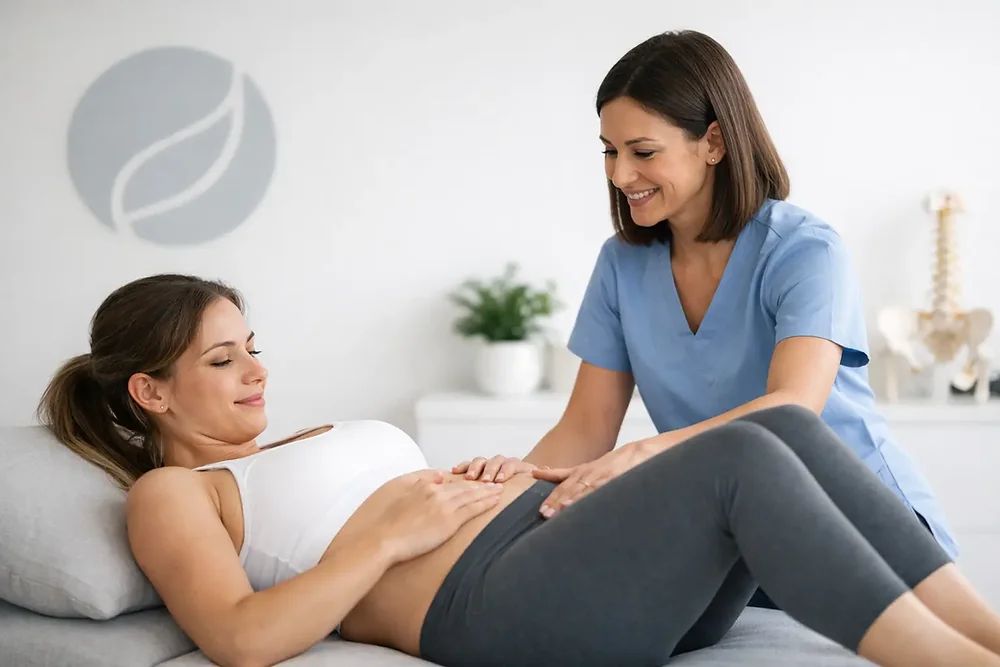
That first attempt to roll out of bed after birth can be more revealing than any fitness test. You may notice weakness, heaviness, doming through the tummy, back ache, or simply the feeling that your middle no longer responds the way it used to. A guide to postnatal core recovery should start there - with what real life feels like, not with pressure to “bounce back”.
Postnatal recovery is not about getting your stomach flat again as quickly as possible. It is about helping your body regain support, pressure control, strength and confidence after pregnancy and birth. The core is part of that process, but it does not work in isolation. Your breathing, pelvic floor, abdominal wall, ribcage, back, hips and scar healing all influence how well you recover, move better and feel more like yourself again.
What postnatal core recovery really means
The postnatal core is more than the visible abdominal muscles. Clinically, we are looking at a system that includes the diaphragm, deep abdominal muscles, pelvic floor, spinal support muscles and the way these parts coordinate under pressure. During pregnancy, your abdominal wall stretches, your ribcage changes position, your breathing pattern can alter, and your pelvic floor carries a significant increase in load. Birth then adds another layer, whether that is vaginal delivery, assisted delivery or caesarean birth.
That is why postnatal core recovery rarely responds well to generic abdominal exercises. A programme that suits one person at six weeks may be completely wrong for someone else at four months. It depends on symptoms, birth experience, sleep, feeding demands, activity levels, scar sensitivity and whether there is pelvic heaviness, leakage, back pain or abdominal doming.
In practice, good recovery means being able to breathe well, manage pressure through the trunk, tolerate daily tasks, and gradually rebuild strength for the life you want to return to. For some women, that means walking without discomfort and lifting a baby carrier confidently. For others, it means getting back to running, yoga or strength training without fear.
A guide to postnatal core recovery by stages
The early weeks: connection before intensity
In the first few weeks, the priority is not hard exercise. It is healing, rest where possible, and gently reconnecting with your body. Breathing work is often the best place to start because it influences both abdominal and pelvic floor function. If your breathing is shallow and held high in the chest, your core system often struggles to coordinate efficiently.
Gentle work might include relaxed diaphragmatic breathing, soft pelvic floor contraction and release, and supported movements such as rolling in bed, standing up from a chair and short walks. These small things matter. They teach your body how to share load again.
This stage can feel frustrating, especially if you were active before pregnancy. But doing too much, too soon can increase symptoms such as dragging, leaking, abdominal bulging or pain around a caesarean scar. Recovery is not a race, and early restraint often creates better long-term progress.
After initial healing: rebuilding support and control
Once tissues have had some time to settle and you are coping reasonably well with daily life, the focus usually shifts towards control and endurance. This is where people are often told to “do core”, but quality matters more than quantity.
Useful exercises are usually simple at first: breath-led abdominal activation, heel slides, supported leg movements, bridges, sit-to-stand control, and gentle rotation work. The aim is not to brace as hard as possible. It is to create a responsive core that can adapt to movement and load.
If you notice doming through the midline, breath-holding, pelvic floor symptoms or increased back pain during an exercise, that is useful feedback. It does not mean you have failed. It means the exercise may need adjusting. Position, range, speed and breathing can all change how manageable a movement feels.
The return to higher load: strength for real life and sport
Later recovery often needs more than mat-based exercises. Eventually, your core has to support carrying, lifting, pushing a buggy, climbing stairs, getting up from the floor, and perhaps returning to the gym or sport. A good programme progresses towards these demands rather than staying with low-level rehab for months on end.
That may involve resistance work, single-leg balance, split squats, deadlift patterns, loaded carries and impact preparation. The right timing varies. If symptoms return when load increases, that does not always mean you should stop completely. It may mean the progression was too fast, recovery capacity is low, or another part of the system needs support.
Common signs you may need more guided support
Some uncertainty is normal after birth, but there are times when professional assessment is particularly helpful. Persistent abdominal doming, pelvic heaviness, leaking, pain during exercise, scar discomfort, back or pelvic pain, or a continued sense of instability are all signs that your recovery plan may need to be more individualised.
It is also worth seeking support if you have returned to exercise but feel you are compensating everywhere else - gripping through your ribs, clenching your bottom, straining your neck, or avoiding movements that used to feel natural. Many women are told these things are just part of motherhood. They are common, but they are not something you have to simply put up with.
Why breathing and pressure matter so much
One of the most overlooked parts of postnatal rehabilitation is pressure management. Every time you lift, cough, stand up, push, pull or exercise, pressure moves through your trunk. If the abdominal wall, diaphragm and pelvic floor are not coordinating well, that pressure may be poorly managed and symptoms can show up quickly.
This is why endless crunches, planks or high-impact classes are not always the best first step, even months after birth. They are not inherently bad exercises, but they require a level of pressure control that may not yet be there. Equally, avoiding challenge forever is not the answer either. The goal is to build that control gradually so your body can tolerate more.
Caesarean birth, abdominal separation and scar recovery
A guide to postnatal core recovery should also make space for caesarean recovery and abdominal separation, often called diastasis recti. Both are common, and both benefit from calm, tailored support rather than fear.
With caesarean birth, scar mobility, tenderness, altered abdominal sensation and protective movement patterns can all affect how the core works. Gentle scar care, movement retraining and graded strengthening can make a significant difference. With abdominal separation, the width of the gap matters less than how well the tissues manage load. Some separation is normal. What matters more is function, support and symptom response.
This is where one-to-one assessment can be especially valuable. Looking at movement, breathing, scar mobility and exercise response gives a much clearer picture than a one-size-fits-all checklist.
How to make progress without overdoing it
The most sustainable postnatal rehab plans fit around real life. That means sleep disruption, feeding, work, stress and limited time all need to be considered. A programme only works if it is realistic enough to do consistently.
For many women, five to ten minutes done well is more useful than a long routine that never happens. It is also helpful to think beyond formal exercise. How you lift your baby, carry a changing bag, get in and out of the car, or return to a gym class all shape recovery.
Progress is rarely linear. Some weeks you will feel stronger. Other weeks you may feel more tired, symptomatic or emotionally stretched. That does not erase your progress. It just means the plan may need to flex with your circumstances.
At eve Clinic, this is why postnatal rehabilitation is approached as a combination of hands-on care, clear assessment and practical exercise guidance. The aim is not to hand over a generic sheet of abdominal exercises. It is to understand what your body needs so you can build strength safely and with confidence.
When can you return to exercise?
There is no universal timeline. General postnatal checks can be useful, but being told you are “cleared” does not automatically mean your body is ready for impact, running or heavy lifting. Readiness depends on symptoms, strength, pressure control, pelvic floor function, scar healing and how you cope with daily tasks.
A gradual return is usually best. If walking, lifting, getting up from the floor and basic strength work are comfortable, you can often build from there. If impact brings on heaviness, leaking or pain, it is worth pausing and reassessing rather than pushing through.
The right question is often not “How soon can I get back?” but “What does my body need to get back well?” That shift tends to produce better outcomes and fewer setbacks.
Postnatal core recovery is not about perfection, and it is certainly not about shrinking yourself. It is about restoring support where you need it, rebuilding trust in your body, and creating enough strength for the demands and joys of life after birth. If something still does not feel right, that is not a sign to ignore it. It is a good reason to get the right help and give your recovery the care it deserves.