
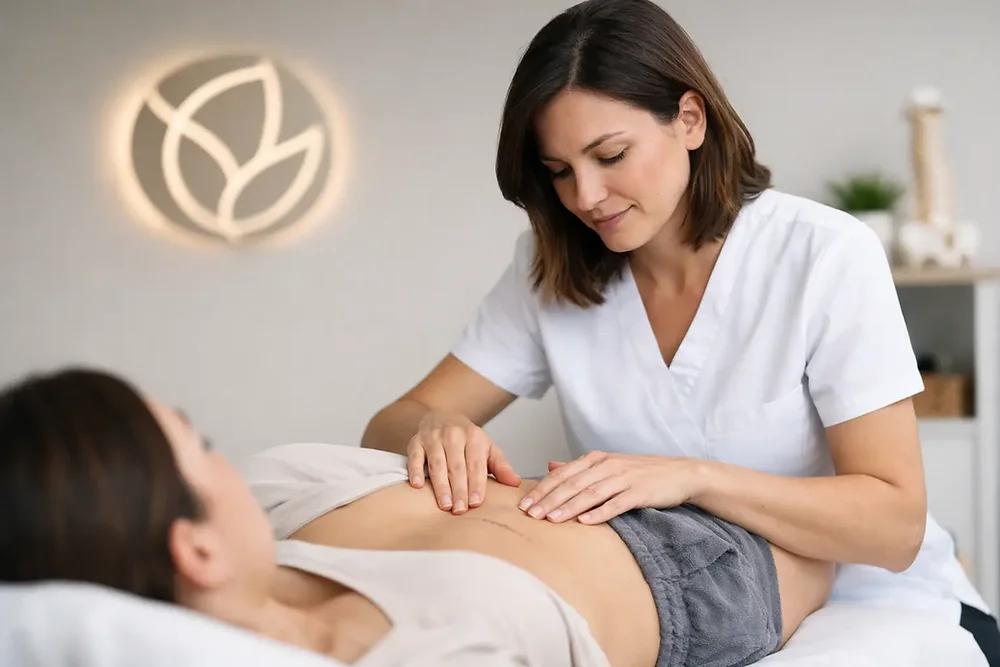
Six months after giving birth, our patient could carry her baby for only short periods before a pulling pain spread across her lower abdomen and into her hip. Rolling in bed felt awkward, standing up from the sofa needed a brace through her arms, and any attempt to return to exercise brought a heavy, tight sensation around her caesarean scar. This caesarean scar recovery case study shows how a careful blend of assessment, hands-on treatment, movement retraining and practical pacing can help someone feel more comfortable, more capable and more confident in their body again.
Why a caesarean scar can affect more than the scar itself
A caesarean scar is not just a line on the skin. The tissues underneath also heal, and that process can influence how the lower abdomen, trunk, pelvis and hips move together. Some women notice local tenderness or numbness. Others describe tightness when reaching overhead, discomfort during brisk walking, or a sense that their core no longer responds in the way it used to.
That does not mean something has gone wrong. It means recovery can be more layered than many people are led to expect. Sleep disruption, feeding positions, lifting and carrying, reduced time for exercise, and the sheer physical demand of caring for a baby all shape how the body adapts after birth and surgery.
In clinic, this matters because the scar rarely exists in isolation. A person may present with abdominal pulling, low back ache, rib tension, hip stiffness or pelvic floor heaviness, all of which can be influenced by how they are moving, bracing, breathing and loading through daily life.
Caesarean scar recovery case study: the starting point
The patient in this case study was a 36-year-old first-time mother working in a demanding office-based role in London. Her baby was delivered by planned caesarean section after a complex late pregnancy. By the time she came for treatment, she had been medically discharged and wanted to rebuild strength safely, but she felt stuck between being told to "give it time" and being unsure what was normal.
Her main concerns were a firm, tender scar, a dragging feeling across the lower abdomen, discomfort around the right hip when walking for more than 20 minutes, and difficulty engaging with exercise without feeling worse the next day. She was also avoiding lying on her front and felt anxious about touching the scar at all.
On assessment, several factors stood out. The scar area was sensitive and relatively immobile compared with the surrounding tissue. Her lower trunk strategy was protective - she held tension through the upper abdomen and ribs, with shallow breathing and limited abdominal expansion. She also had reduced rotation through the thorax and pelvis, which made everyday movements like turning, carrying and getting up from the floor more effortful than they needed to be.
This is where individual assessment matters. Two people can both say, "my scar feels tight", but the driver may be quite different. For one, it may be local sensitivity. For another, it may be a wider movement pattern, deconditioning or uncertainty about loading.
What the treatment plan focused on
The plan was not built around forcing the scar to "break up" or trying to push through discomfort. Instead, the aim was to support tissue mobility, reduce protective tension, improve movement confidence and gradually reintroduce strength in a way that fitted around a busy postnatal routine.
Hands-on treatment focused first on the areas around the scar rather than the scar alone. That included the lower abdomen, hips, ribcage and lower back, with a gentle approach designed to improve comfort and help the body tolerate movement more easily. Direct scar work was introduced gradually once the patient felt ready and understood what she was doing and why.
Rehabilitation was equally important. Early exercises centred on breathing mechanics, trunk control and low-load coordination rather than intense core work. That often surprises people. Many expect recovery to begin with stronger exercises, but if the body is still guarding, more effort can simply reinforce the wrong pattern.
We also spent time on practical changes. Feeding posture, how she lifted the car seat, how she moved from lying to sitting, and how she paced walking all had a direct effect on symptoms. When someone is repeating the same irritating load dozens of times a day, small changes can make a meaningful difference.
What changed over the first six weeks
By the end of the second session, the patient reported that the scar felt less "stuck" and the surrounding tightness eased more quickly after activity. She was still aware of the area, but it no longer dominated every movement. Just as importantly, her confidence improved. She had started gentle scar contact at home and no longer feared making things worse.
At four weeks, she was walking for 35 minutes without the same dragging discomfort. Getting in and out of bed felt smoother, and she had returned to short home exercise sessions without a flare-up the following day. There was still some tenderness, especially by the end of a busy week, but it was more predictable and less intense.
At six weeks, her hip discomfort had reduced significantly, trunk rotation had improved, and she was able to carry her baby for longer with less strain through the abdomen. The scar itself was softer and more mobile on palpation, but the more meaningful outcome was functional - she could move through her day with less hesitation.
The turning point in this caesarean scar recovery case study
The biggest shift was not one technique or one exercise. It was the moment the patient stopped treating her abdomen as an area to avoid. Once she understood that sensitivity, stiffness and altered movement could improve gradually with the right support, her approach changed.
That change matters because recovery is not only physical. Many postnatal women are managing uncertainty, pressure to "bounce back", and a lack of clear guidance tailored to their real life. When care is respectful and specific, it becomes much easier to rebuild trust in the body.
There were still trade-offs. On poor sleep weeks or days involving more lifting and travel, symptoms could return slightly. That did not mean she was back at the beginning. It meant the body still had limits, and the plan needed to reflect them. Good rehabilitation is rarely linear.
What this case study tells us about caesarean scar recovery
First, time helps, but time alone is not always enough to restore ease of movement. If a scar remains sensitive, tight or functionally limiting, it can influence how the rest of the body works.
Second, effective recovery is usually broader than scar massage in isolation. Scar mobility can be helpful, but so can breathing work, trunk coordination, hip mobility, graded strength and advice that makes daily tasks less aggravating. It depends on the person in front of you.
Third, reassurance should never mean dismissal. Being told that symptoms are common is not the same as being supported through them. Many women feel relieved simply to hear that their experience is recognised and that there is a clear, sensible route forward.
Finally, progress should be measured by function as well as sensation. A scar may still feel slightly numb or sensitive for some time, but if walking is easier, lifting is more comfortable, exercise is returning and confidence is growing, those are meaningful markers of recovery.
When support is worth considering
If a caesarean scar is affecting how you sit, stand, walk, exercise or care for your baby, it is reasonable to seek support. The same applies if you feel apprehensive about touching the area, notice persistent pulling through the abdomen, or feel that your movement has not settled in the way you expected.
Early support can be helpful, but so can later support. We regularly see women months or even years after birth who assumed they had simply missed the window to improve. In many cases, that is not true. With the right assessment and a tailored plan, there is often scope to recover movement, reduce discomfort and feel more at home in your body again.
At eve Clinic, that work is approached as part of the bigger postnatal picture - not just the scar, but the way you move, load, breathe and manage daily life around it.
If there is one useful thought to keep, it is this: caesarean scar recovery does not have to mean forcing your body forwards. Often, the best progress comes from understanding what it is protecting, giving it the right input, and letting confidence return step by step.