
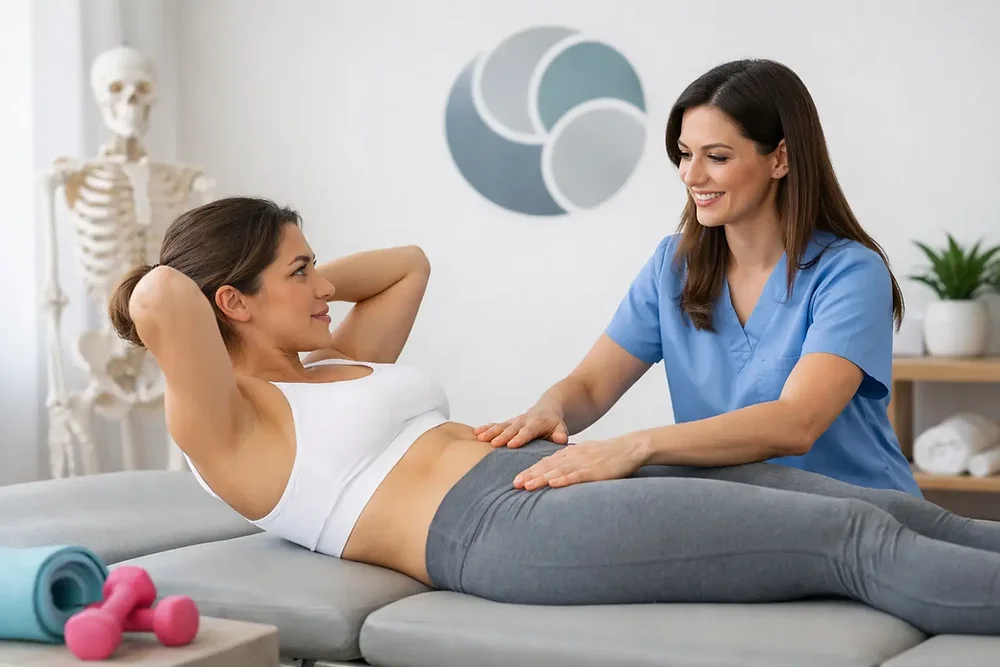
A tummy that still feels unsupported months after birth can be unsettling, especially when you are trying to return to exercise, lift your baby comfortably, or simply feel more like yourself again. Diastasis recti rehabilitation is not about chasing a flat stomach. It is about helping your abdominal wall work well, improving pressure control, and rebuilding confidence in movement.
For many women, the first sign is a lingering bulge or a sense of weakness through the middle of the abdomen. Others notice back discomfort, poor control when lifting, or a doming shape during certain exercises. These changes can feel worrying, but they are also common. The key is knowing what matters, what does not, and how to approach recovery without fear.
What is diastasis recti?
Diastasis recti is a widening of the linea alba, the connective tissue that runs down the centre of the abdomen between the two sides of the rectus abdominis muscles. It often develops during pregnancy as the abdominal wall adapts to a growing baby, hormonal changes and shifting pressure within the trunk.
A separation itself is not automatically a problem. Width alone does not tell the whole story. What matters more is how the tissue behaves, how well the abdominal wall generates tension, how you manage pressure, and whether you are experiencing symptoms that affect daily life.
That point is often missed online. Many people are told to measure a gap with their fingers and assume that number determines everything. In practice, recovery is more individual than that. Two women can have a similar separation and very different levels of function.
When does it need rehabilitation?
Not everyone with diastasis recti needs formal treatment, but many benefit from guided rehabilitation, particularly if they notice weakness, doming, pelvic floor symptoms, back or pelvic discomfort, or uncertainty about returning to exercise.
The best time to start is not always the earliest possible moment. In the early postnatal phase, your body is already recovering from enormous physical change. Gentle reconnection work, breathing, position changes and sensible load management can be useful quite soon, but harder strengthening should be introduced at the right pace. Pushing too fast can leave you frustrated, while waiting too long out of fear can also hold you back.
Diastasis recti rehabilitation is about function, not perfection
This is where a lot of misinformation begins. Social media often frames recovery as a before-and-after body transformation, but clinically that is too narrow. Effective diastasis recti rehabilitation aims to improve the way your whole system works together - abdominal wall, diaphragm, pelvic floor, ribcage, spine and hips.
That means your programme may not look like endless abdominal exercises. It may include breathing retraining, pelvic floor coordination, posture advice, glute and hip strength, and practical strategies for lifting, rolling, coughing and returning to impact. A stronger core is not just about the front of the abdomen. It relies on coordinated pressure management across the whole trunk.
Why generic advice often falls short
You may have seen blanket rules such as never do sit-ups, never plank again, or avoid all twisting. These statements are usually too simplistic. Some exercises are unhelpful at certain stages, and some may need modification, but permanent avoidance is rarely the goal.
Rehabilitation should match your symptoms, your healing stage, your fitness history and your goals. A woman returning to office work after a first baby has different demands from someone training for a half marathon or managing the physical load of caring for twins. Good rehabilitation respects that difference.
It also recognises that the abdominal wall does not work in isolation. If breathing mechanics are poor, the ribcage is stiff, the pelvic floor is under strain, or the scar from a caesarean birth is affecting movement, progress may stall unless those factors are addressed.
What a thorough assessment should look at
A useful assessment goes beyond checking the width of a gap. It should consider the depth and tension of the midline, how your abdomen responds during effort, your breathing pattern, posture, movement habits, pelvic floor symptoms, exercise history, and any discomfort that appears during daily activities.
For some women, the main issue is a feeling of instability when lifting or carrying. For others, it is doming during exercise or a lack of confidence returning to running, Pilates or strength work. Some are also recovering from a difficult birth, abdominal surgery or ongoing pelvic discomfort. These details shape the plan.
At eve Clinic, this kind of one-to-one assessment matters because recovery is rarely linear or identical from one person to the next. Being listened to properly is part of effective care.
How diastasis recti rehabilitation usually progresses
Stage 1: Reconnect and reduce strain
Early work often centres on breath control, gentle deep abdominal activation and finding positions where the abdominal wall can respond without excessive pressure. This is not about sucking in or bracing hard. It is about restoring a more natural relationship between the breath, abdominal wall and pelvic floor.
You may also need practical changes to reduce unnecessary strain, such as how you get out of bed, how you lift the car seat, or how you return to bowel habits that do not overload the abdominal wall.
Stage 2: Build strength with control
As your control improves, exercises usually become more dynamic. That may include supported leg movements, resisted upper and lower body work, bridges, carries and modified plank-based exercises if appropriate. The aim is to create tension through the abdominal wall without doming or breath-holding.
This stage is often where confidence begins to return. You are not just exercising the gap. You are teaching your body to transfer load better in everyday movement.
Stage 3: Return to full activity
Later rehabilitation becomes more specific to your goals. If you want to get back to yoga, running, gym training or lifting heavier weights, your programme should prepare you for exactly that. This is where broad rules become less useful and tailored progression becomes essential.
Some women are ready for impact quite quickly. Others need more time, particularly if they also have pelvic floor symptoms, scar sensitivity, sleep deprivation or persistent pain. That does not mean recovery is failing. It means the plan needs to reflect real life.
Common mistakes that can slow progress
One of the most common problems is doing too much too soon because you are desperate to feel stronger again. Another is doing too little for too long because you have been told your body is fragile. Most postnatal women need a middle ground.
Poorly chosen online exercise programmes can also be a problem. If they do not account for your breathing pattern, your symptoms or your movement quality, they may leave you working hard without actually improving function.
Then there is the mental side of recovery. If every movement feels like a test of whether your stomach looks flat enough, it becomes difficult to judge progress fairly. Better markers include improved strength, less doming, more comfort when lifting, better bladder control, easier posture and greater trust in your body.
When to seek professional support
If your abdomen still feels weak or unsupported, if you are unsure how to exercise safely, or if you notice ongoing doming, pelvic heaviness, leaking or discomfort with daily tasks, an assessment can give you clarity. You do not need to wait until things feel severe.
Support can be especially valuable if you are returning to demanding activity, recovering after a caesarean birth, or feeling confused by conflicting advice. Hands-on assessment and tailored rehabilitation can often move things forward more efficiently than guesswork.
What good recovery can look like
For some women, successful rehabilitation means getting back to sport without symptoms. For others, it means carrying a child, going back to work, sleeping more comfortably, or no longer feeling anxious every time they engage their core. The tissue at the midline may change over time, but recovery is not judged by appearance alone.
A well-designed rehabilitation plan should help you feel stronger, move better and rely less on avoidance. It should give you practical tools you can use in the middle of real life, not just during a short exercise session on the mat.
If you are dealing with diastasis recti, you do not need scare tactics or one-size-fits-all rules. You need clear guidance, a realistic plan and support that respects both your body and your goals. Recovery is rarely about doing everything perfectly. It is about steady, informed progress that helps you feel more capable in your own body again.